
For example, there is no entry for disability in Maggie
Humm's The Dictionary of Feminist Theory (Harvester Wheatsheaf,
London, 1989), nor in her Feminist Criticism (Harvester Press, Brighton,
1986). Humm states that: "A fundamental goal of feminist theory is
to understand women's oppression in terms of race, gender, class and sexual
preference" (Humm, Maggie, The Dictionary of Feminist Theory,
Harvester Wheatsheaf, London, 1989, px) - disability is of course missing
from this list. Later she writes that: "Dictionaries have a particular
role as authorities and women and minorities are often made invisible or
stereotyped in them" (pxv) and that "hidden women" is "a
term used by feminist historians to describe the virtual exclusion of women
. . . from research", underlining the significance of her exclusion
of disability. It is also significant that Humm has a listing for "health",
possibly reflecting the medical model of disability.
Likewise Liz Stanley and Sue Wise discuss only "black feminist and lesbian feminist" epistemologies in their section on "Silenced feminist standpoints". (Stanley, Liz, & Wise, Sue, "Method, methodology and epistemology in feminist research process", in Stanley, Liz [ed.], Feminist Praxis, Routledge, London, 1990, p25). And the Lesbian History Group ignores constructs of disability in Not a Passing Phase: Reclaiming Lesbians in History 1840-1985 (The Women's Press, London, 1989), despite including race and class perspectives and acknowledging that "every social group needs access to its own history" (p2). Instead they describe the public perception of lesbianism as being "at best a pitiful handicap" (p6).
Lisa Tuttle does discuss "disabled women" in the Encyclopedia of Feminism (Longman, London, 1986), in relation to disabled women "being even more oppressed by the stereotypes of femininity than are their temporarily able-bodied sisters". She goes on to write that "During the 1980s, more and more feminists became aware of the connection between SEXISM and ABLEISM, recognizing the same destructive myth of the "perfect" and "normal" person at the root of oppression, and began to confront the unconscious ableism within the women's movement." However, this seems to me to discuss disability solely in relation to feminism, rather than also discussing feminism in relation to disability theory and politics.
| Dr Ju Gosling aka ju90's ABNORMAL: How Britain became body dysphoric and the key to a cure is available now for just £3.09 for the Kindle or in a limited-edition hardback with full-colour art plates for £20 inc UK postage and packing. | 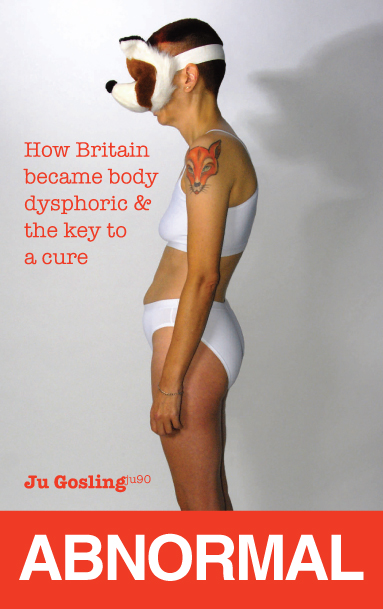 |